Many people describe the exit process as scripted, careful and legal in tone. That is not a sign that anyone is acting in bad faith. It is a sign of who is on the other side of the table: people whose job is to protect the company, doing that job well. Nobody in that room is assigned to protect you. That is what we mean when we say the playing field is not level.
What we measured
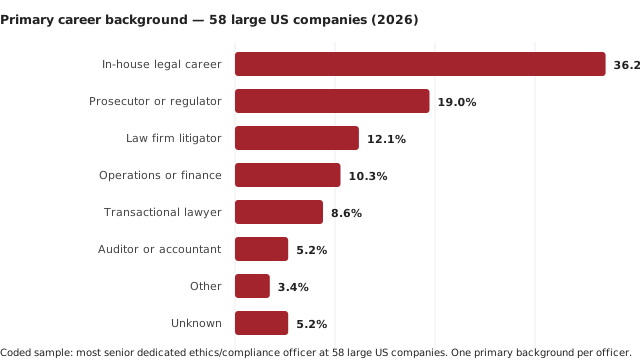
We coded the public career histories of the most senior ethics or compliance officer at58 large US companies (30 technology companies and 28 other Fortune 500 scale firms), using company leadership pages, SEC filings, trade press, conference biographies, bar records and public professional profiles. Each officer was given one primary background, with separate flags for a law degree, law-firm litigation, government service, and employment-law or workplace-investigations work.
The rest split between long in-house legal careers (36%), operations and finance (10%), transactional law (9%), accounting and audit (5%), and other backgrounds.
Where the leaders come from
Technology companies look like the rest
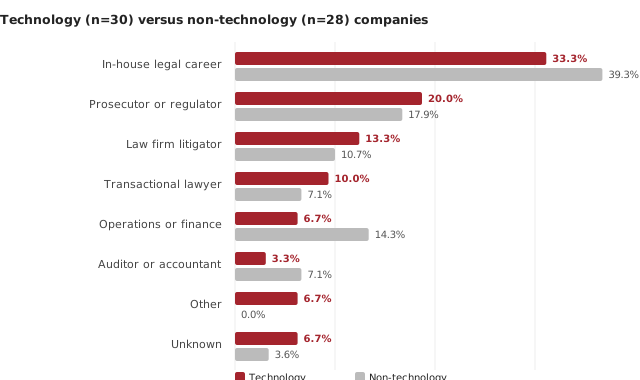
Splitting the sample, the lawyer share barely moves: 80% in technology versus78.6% elsewhere. Technology compliance leaders are slightly more likely to come from enforcement (20% versus 18%) or litigation (13% versus 11%).
What this does and does not show
It shows that at large companies, the functions that set conduct policy and handle complaints are led mostly by lawyers. It does not show who drafts any particular separation agreement. Those are usually prepared by HR and employment counsel, inside the company or at an outside firm, which is a further reason the documents read the way they do.
It also does not show bad intent. Protecting the company is a legitimate job. The point is the imbalance: one side has trained professionals, templates and time, and the other side has a deadline. Small procedural rules can narrow that gap without taking anything from employers.
What this means for a worker
Read the agreement as a careful legal document, because it is one. Many people slow down, ask questions in writing, keep every version, and get advice before signing. TheRight to a Final Copy proposal asks for three procedural rules that make that easier for everyone: the signed agreement delivered by default, in a format you can open, with changes marked before you sign.
Method and limits
This is a coded sample of 58 large US companies, not a census. Because it focuses on the largest employers, it likely overstates the lawyer share for the compliance profession as a whole. At 12 of the 58 companies the function sits within a combined legal or executive role, and the company was coded accordingly. Twenty-two of 58 law-firm litigation flags could not be confirmed from public sources, so the 37.9% "ever litigated at a firm" figure is a floor. Per-company source notes are kept for fact-checking. No individual or company is named in this public version.
Where this work goes next
- Compare the sample with profession-wide survey data on compliance backgrounds.
- Extend the sample to HR and employment counsel, who prepare most separation paperwork.
- Review published research on whether officer background affects outcomes.
Corrections are welcome at hello@righttoafinalcopy.org. Each change to this paper will be dated here.